



Outline
This life-size patient care female manikin is designed to meet the needs of hospitals, nursing and educational facilities in training patient care, with fully articulated limbs and torso for flexibility offering training opportunities in patient handling and transfer. It allows exercises of basic care as well as specialized care, and provide comprehensive simulation experience for students.
Skills Gained
Administration route:
· Ophthalmic administration
· Administration of ear drops
· Sublingual administration
· Vaginal suppository insertion
Injection and Puncture:
· Intramuscular injection
· IV injection and infusion
· Intradermal injection
· Arterial Puncture
Fundamental Nursing Skills:
· Mouth care
· Hair care
· Enema
· Nasal feeding
Specialized Nursing Skills:
· Tracheotomy care
· Catheterization and indwelling urethral catheterization
· Deep venous access
· Closed thoracic drainage care
· T- tube drainage care
· Ostomy care
· EVD Care
· Decubitus care
· Diabetic Foot Care
Vital Signs Monitoring:
· Pupils observation and demonstration
· Auscultation
· Blood pressure measurement
Emergency skills:
· Ventilation and intubation
· Gastric lavage
· CPR
Features
Anatomy:
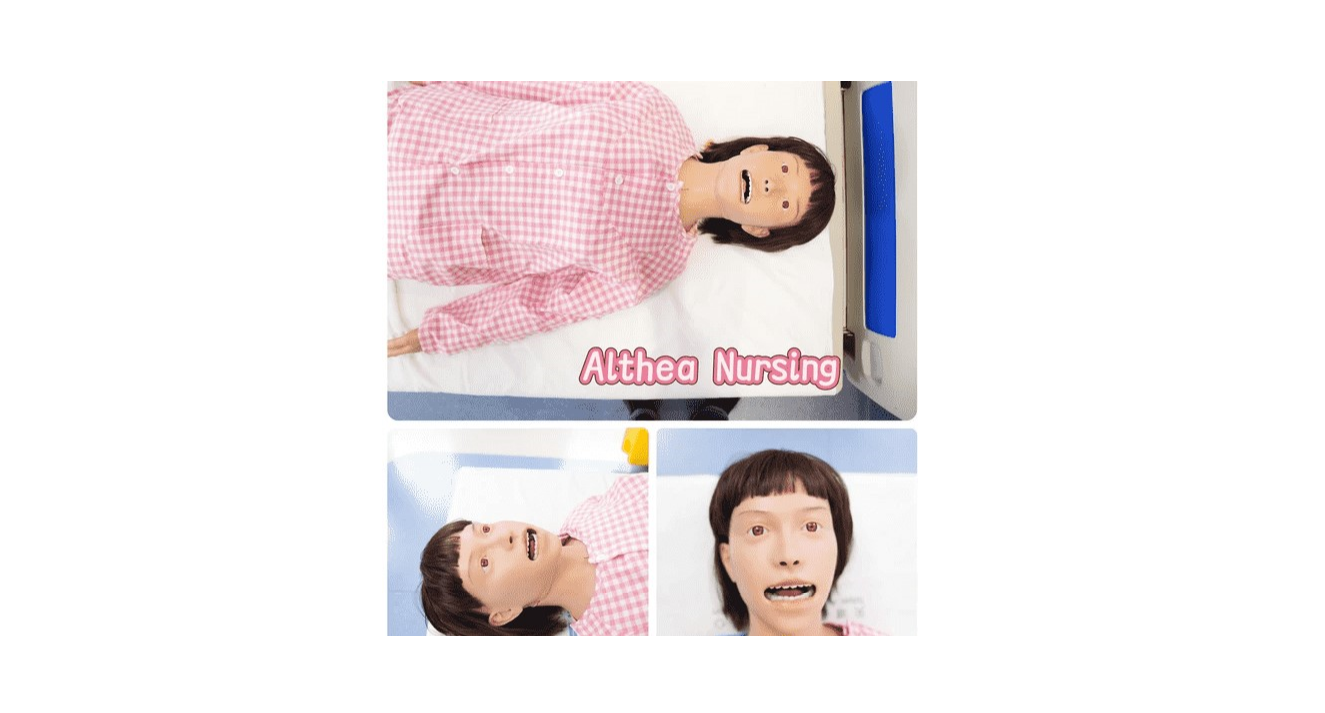
· Realistic appearance simulator with height of 165cm.
· Bilateral shoulder joints, elbow joints, wrist joints, hip joints, knee joints, and ankle joints can meet the physiological range of motion. The neck and waist are flexible and can be positioned in supine position, semi-sitting position, sitting position (either on bed or in a wheelchair), lateral recumbent position, supine position with hips and knees flexed.
1) Neck: rotation (anterior and posterior), flexion and extension, and lateral flexion.
2) Shoulder joints: flexion and extension, adduction, abduction, internal rotation, external rotation, and circumduction movement.
3) Elbow joints: flexion and extension, pronation, and supination.
4) Wrist joints: flexion and extension.
5) Hip joints: flexion and extension, abduction, adduction, internal rotation, external rotation, and circumduction movement.
6) Knee joints: flexion and extension, and internal and external rotation.
7) Ankle joints: dorsiflexion (extension) and plantarflexion.
8) Waist: flexion and extension with a range of motion of more than 10°.
· The surface landmarks include: auricle, external auditory canal, mandibular angle, submandibular fossa, sternocleidomastoid muscle, clavicle, acromion, deltoid muscle, suprasternal notch, sternal angle, xiphoid process, bilateral nipples, costal margin, umbilicus, anterior superior iliac spine, pubic symphysis, anal cleft, and iliac crest, etc.
Key features:
Cephalic and Facial Region
· Ophthalmic administration: Gently pull down the lower eyelid and instill the medication into the inferior conjunctival fornix.
· Pupils observation and demonstration: Dilated, normal and constricted pupils on both sides.
· Mouth care: With realistic structures including lips, teeth, tongue, gums, palate, etc. It supports the vibration method and Leonard brushing technique for toothbrushing operations.
1) Close the upper and lower teeth, and use a tongue depressor to hold open the left/right cheek, then wipe the left/right labial surface of the teeth longitudinally.
2) Open the upper and lower teeth, and wipe the lingual surface and the occlusal surface of teeth.
3) Denture care: Providing removeable dentures, cleaning operations can be performed.
· Administration of ear drops: With realistic structure including external acoustic meatus and auricle, it supports the dripping of medication, wearing of hearing aids, glasses, and the hanging of oxygen tubes, etc.
· Sublingual administration: With realistic tongue structure, the tip of the tongue can be raised to show the base of the tongue and the sublingual venous plexus.
· Hair care: Providing wig, supporting the cleaning and combing operations.
· EVD care: Supporting the drainage of cerebrospinal fluid, disinfection and securing of the drain tube.
· Nasal feeding and gastric lavage: It allows for measuring the length of gastric tube insertion, including measuring the distance from the hairline of forehead to the xiphoid process or the distance from the tip of the nose, passing the earlobe, to the xiphoid process. The measurement result falls within the normal adult range. After the gastric tube has been inserted into the stomach, it can extract the gastric juice in a real way and allow for hearing the sound of air bubbles passing through the liquid by auscultation. It supports medication administration and food perfusion, with a perfusion volume of ≥300 ml.
Cervical Region
· Ventilation and intubation: With realistic airway structure, including palatoglossal arch, palatopharyngeal arch, tonsils, glottis, epiglottis, uvula, trachea, etc. It allows for orotracheal and nasotracheal intubation, as well as the placement of nasopharyngeal and oropharyngeal airways and laryngeal mask operations.
· Tracheotomy care: It allows for the cleaning, replacement, and disinfection of the tracheal tube, supporting suctioning of sputum through the tracheotomy site.
· Deep venous access: It supports deep vein catheters via the internal jugular vein and subclavian vein and corresponding fluid infusion and nursing care can be performed.
Thoracic & Abdominal Region
· Closed thoracic drainage care: Disinfection and securing the drainage tube can be performed on the 6th to 7th intercostal space of both mid-axillary lines.
· CPR:
1) Pulse pulsation can be generated manually at both carotid arteries.
2) Chest compression: Real compression feeling, the maximum compression depth is ≥6 cm, allowing for chest recoil.
3) Ventilation: It supports the head-tilt chin-lift method and jaw thrust technique to open the airway. The mandibular joint is flexible which allows for mouth opening and closing, supporting various ventilation methods such as mouth-to-mouth and bag-valve-mask ventilation. Chest movement can be observed after ventilation.
· Ostomy care:
1) Gastrostomy and jejunostomy: The fistula openings are located on the lower left abdomen and upper left abdomen separately, allowing for the disinfection and cleaning of the skin around fistula as well as food perfusion training, with perfusion volume of ≥300ml.
2) Colostomy: The fistula opening in circular and protruding shape is located on the lower right abdomen, with pink mucosa on the surface. It allows for the cleaning of excretions, and supports the changing of artificial anal bags.
3) Cystostomy: The fistula opening is located above the pubic symphysis. It allows for disinfection and dressing changes of the surrounding skin, and supports bladder irrigation training with an irrigation volume of ≥500ml.
· T- tube drainage care: supporting operations including pipeline disinfection, bile drainage, drainage tube securing and drainage bag replacement.
· Auscultation: heart sounds, breath sounds, bowel sounds
1) Thoracic and dorsal auscultation:
Heart sounds: Supports auscultation of normal/abnormal heart sounds
at five areas:
? Mitral area
? Pulmonary area
? Aortic valve area
? Erb’s point
? Tricuspid valve area
Breath sounds: Supports auscultation of normal/abnormal breath
sounds at eight areas:
? Anterior left upper/lower chest
? Anterior right upper/lower chest
? Posterior left upper/lower scapular regions
? Posterior right upper/lower scapular regions
2) Abdominal Auscultation:
Bowel sounds: Supports detection of normal/abnormal bowel sounds at
five areas:
? Left upper quadrant (LUQ)
? Left lower quadrant (LLQ)
? Right upper quadrant (RUQ)
? Right lower quadrant (RLQ)
? Periumbilical area
Genital & Perineal Region
· Catheterization and indwelling urethral catheterization: The simulator can maintain the lithotomy position without any external assistant. The liquid can be drained with successful operation. It is designed for quick tool-free replacement, with changeable male and female genital modules. The external genitalia and perineum mimic the size and texture of a real adult male. The male genital module can be lifted to form a 60° angle with the abdominal wall, allowing for smooth catheter insertion. Realistic narrowing and curvature of the urethra can be felt during catheterization. The male genital module features an integral foreskin structure. The male genital module can be lifted with gauze to retract the foreskin, fully exposing the coronary sulcus for disinfection practice.
· Vaginal suppository insertion: With realistic and complete female genitals including mons pubis, labia majora, labia minora, clitoris, and urethral opening. The labia minora is naturally closed, allowing for the lateral separation of the labia and exposing the urethral opening. With realistic anatomical structures including vagina, cervix, posterior fornix, vaginal suppository insertion can be performed.
· Enema: The simulator is able to independently maintain a lateral decubitus position with hips and knees flexed without any external assistant. The anus is in a naturally closed state. Before the enema procedure, it is necessary to separate the buttocks towards both sides to expose the anus. The anal tube can be inserted to a depth of ≥20cm. The simulator supports massive, small volume, retention, and non-retention enema procedures, with the irrigation volume of ≥1000ml.
· Decubitus:
1) Four stages of decubitus:
Stage 1: Non-blanchable erythema
Stage 2: Partial-thickness skin loss
Stage 3: Full-thickness loss of skin
Stage 4: Full-thickness tissue loss
2) Allowing for practice of wound dressing, classification, assessment, and length measurement.
Limbs
· Intramuscular injection:
1) It supports the injection on both deltoid muscles, with the location determined by two finger widths below the acromion; the injection module has a complete deltoid muscle profile and supports the use of the deltoid muscle nine-section method. Subcutaneous injections can also be administered at the lower edge of the deltoid muscle.
2) Intramuscular injection can be administered in the lateral femoral muscles on both sides.
3) Intramuscular injection can be administered in the bilateral gluteal muscles (gluteus maximus, gluteus medius, and gluteus minimus). The injection site for the gluteus maximus can be located by using the cross method and the line method; the injection sites for the gluteus medius and gluteus minimus can be located. The injection depth is between 2.5 to 3 cm.
4) The modules allow for the realistic injection of liquids and are reusable
· IV injection and infusion: IV injection and infusion can be performed on the back of the hand.
· Arterial puncture: The radial artery puncture can be performed on the left arm. Allowing for simulating arterial pulsation by compressing the inflation bulb, the blood flashback can be seen after successful puncture.
· Intradermal injection: Supporting intradermal injection operations in accordance with clinical standards, the blood flashback can be seen after successful puncture.
· Blood pressure measurement: Non-invasive blood pressure measurement can be performed on the right arm using a real sphygmomanometer and stethoscope. The systolic and diastolic pressures are adjustable with an accuracy of up to 1 mmHg. Korotkoff sounds can be heard, with adjustable volume and pulse rate.
· Diabetic foot:
1) Various symptoms of diabetic foot from grade 1 to grade 5, including superficial ulcer, deep ulcer, infection, edema, decay, necrosis, and etc.
2) Severe foot lesions with invasive trauma on the first, second and third toes, accompanied with neuropathy.
3) The fourth and fifth toes present with gangrene.
Durability:
· The injection modules support quick replacement, with soft and self-healing materials, allowing a single module to perform over 1,000 injection operations.
· Changeable facial skin, allowing quick and tool-free replacement.
Compatibility (Optional):
· Compatible with multiple IV arms and arterial puncture arm via a connector, including Advanced IV Training Arm-Left (TYE1010.60), Advanced IV Training Arm (TYE1010.50), Advanced Arterial Puncture Arm (TYE1020.1)
Different Version for Selection:
Althea Nursing
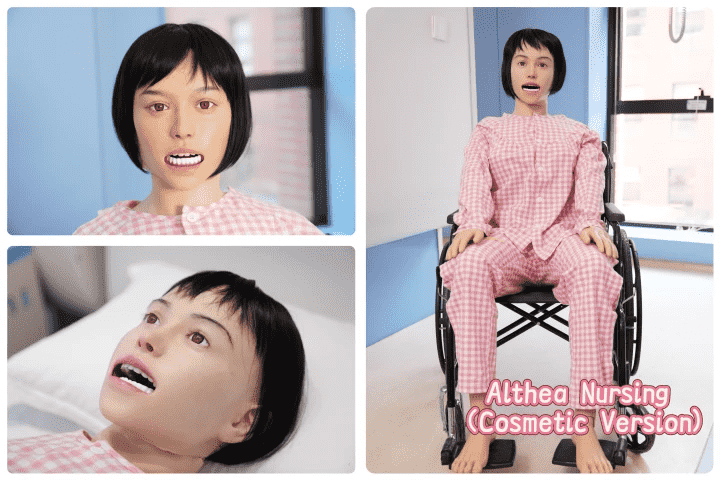
Althea Nursing (cosmetic version)
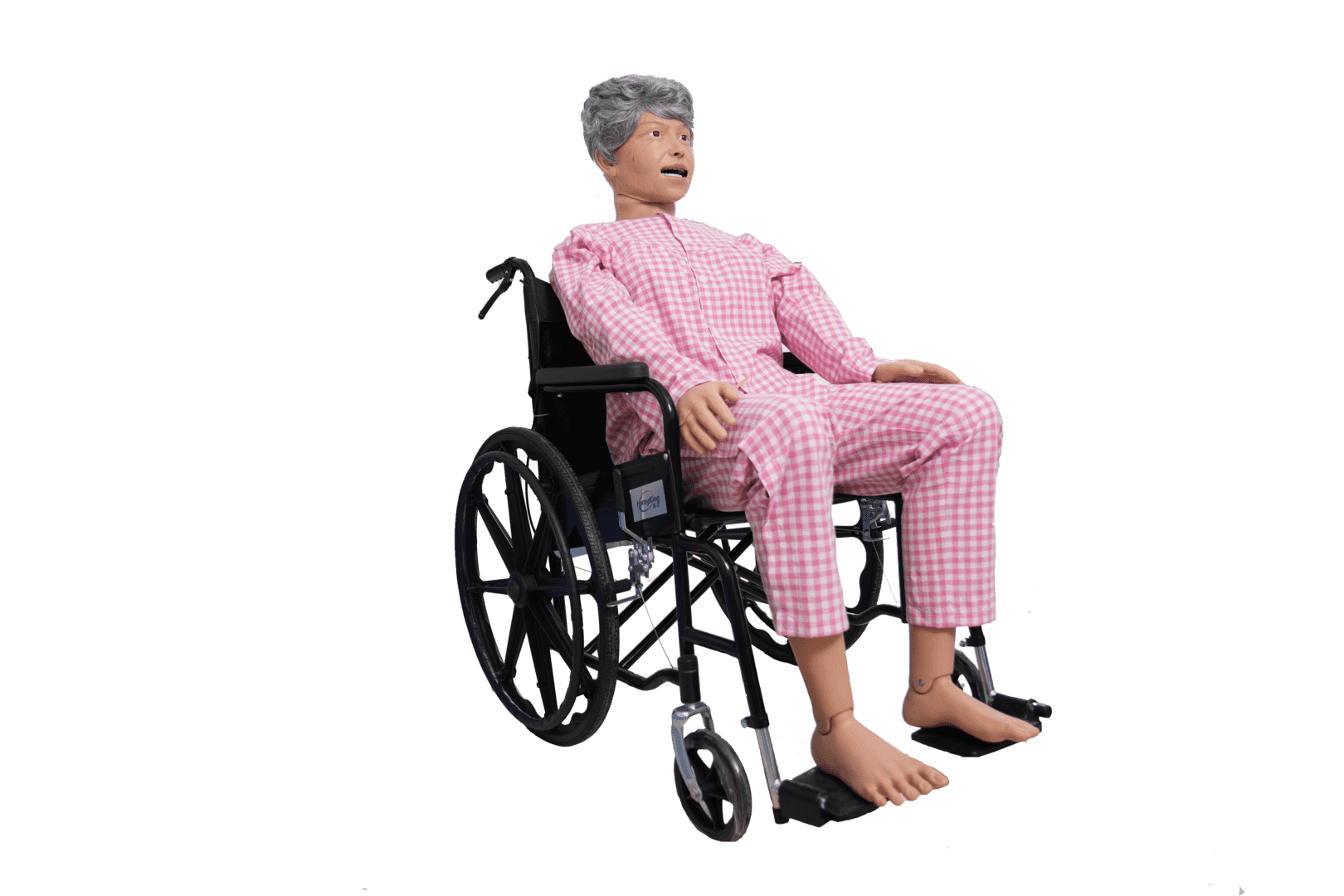
Silver Althea Nursing
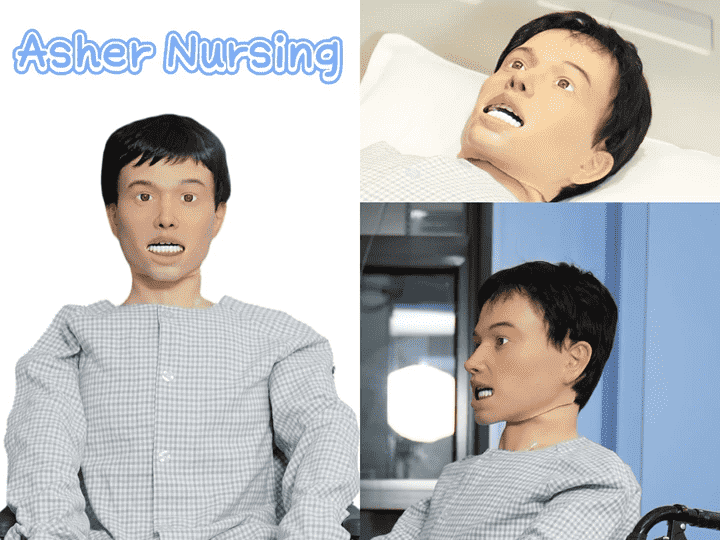
Asher Nursing
Asher Nursing (cosmetic version)

Stock code :833047
Address:2nd & 3rd Floor, West 6th Building, 18 West HaiTai Road, Tianjin, China
Postcode:300384
Phone:4006-355-510
+86-22-83711066
Fax:+86-22-83711065
Email:info@tellyes.com

 Nursing